Custom Search
Showing posts with label PAUL HO. Show all posts

Monday, February 4, 2013

What is a SOHO Property?

by PAUL HO

SOHO stands for Small Office, Home Office. SOHO is simply a marketing terminology developed and used by property developers.

Of note, is that the Urban Redevelopment Authority (URA) does not recognize the planning term SOHO. (http://www.ura.gov.sg/dc/connect/connect11-02/reliable-02.html)

The term SOHO is misleading because it gives the impression that the property can be used as an office or a residential dwelling. It is important that property buyers check what the property is approved for use as.

What is Home Office Scheme?

SOHO is not to be confused with the Home Office Scheme. This scheme allows property owners and tenants of private properties or HDB flats to operate a business out of their residential premises.

You can register up to 2 non-resident employees provided that the business does not cause disturbance or inconvenience to the surrounding residents. The full detail of the Private property home office scheme is specified here: - (http://edanet.ura.gov.sg/dcd/homeoffice/HOMainPage/HOindex.jsp)

The full detail of the HDB property home office scheme is specified here: - (http://www.hdb.gov.sg/fi10/fi10326p.nsf/w/HomeBusinessHomeOfficeScheme)

Business permitted under the Home Office Scheme

The business to be run must not adversely affect the character of the estate. There are certain types of rules and restriction. The types of businesses approved under the Home Office Schemes are: -

• Accountancy services
• Architectural services
• Consultancy services (Business, engineering, IT management or education)
• Design/Advertising services • Insurance/Financial planning services
• Real estate agencies
• Technology based and knowledge intensive businesses
• Transportation services
• Trading offices
(Source: http://edanet.ura.gov.sg/dcd/homeoffice/HOMainPage/HObusinesslist.jsp)

What is the land zoning of a SOHO?

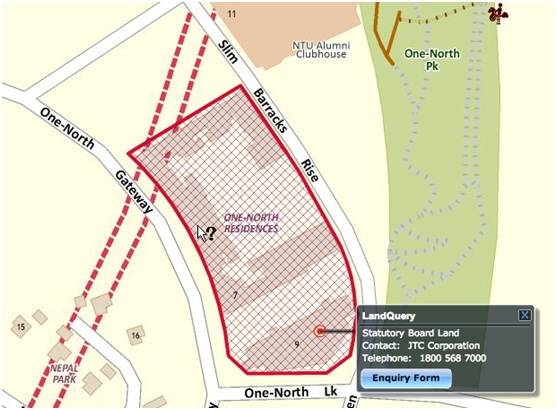
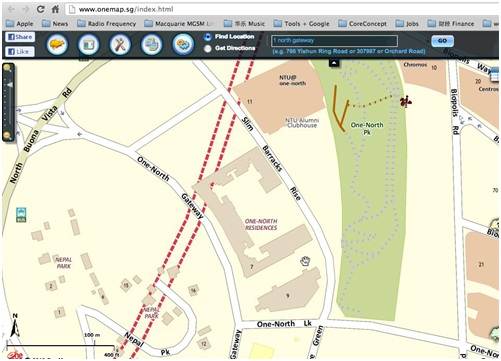
Most SOHO that we see today are zoned under residential land. One such source is from www.onemap.sg.
1-Optimized

Under Lot number Mukim MK03-04324P.

2-Optimized

The land query indicates that the plot of land is owned by JTC corporation; therefore it is uncertain if the reversionary land rights will be transferred back to JTC at the end of the 99- year lease. Or if this land that is being transferred to the property developer now will be returned to the state at the end of the 99-year lease. Reversionary rights and top ups of 99-year leasehold properties shall be a separate topic and a discussion for another time.

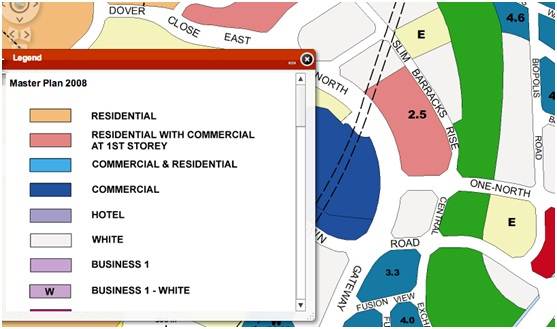
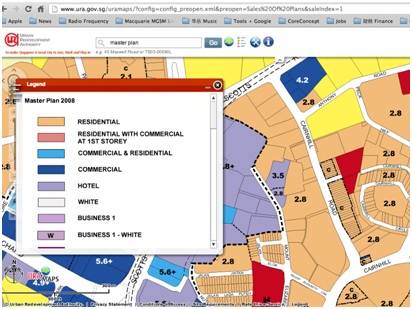
The zone for this One North Residence is “Residential with commercial at 1st storey”.
3-Optimized

(Source: http://www.ura.gov.sg/uramaps/?config=config_preopen.xml&preopen=Sales%20Of%20Plans&saleIndex=1)

The property description captured from one of the websites are: - “One-north Residences, developed by Vista Development, will have about 400 residential units and 20 street retail units. Its design concept leans towards glass and steel, with blocks connected by sky bridges, and fits in with the area’s master plan to create a ‘fenceless’ community.

‘Because there is a limited supply of residential projects there in one-north, demand for housing will be extremely great from expatriates who work there,’

‘People who buy see the potential of the hub. After all, the government has committed to spend $15 billion to develop this city within the city.’

This development will ‘allow like-minded experts and professionals to get together, mingle and socialise within a short walk of their home’ ..”

The units on the 1st floor (Ground level) are supposedly retail units. However the rest of the units are marketed as SOHO.

If you look at the zoning definition, URA master plan states that it’s zoned at 1st floor for Commercial while the rest are zoned as residential. Only the 1st floor is zoned for commercial use, in this case, as retail.

The rest of the units are presumably marketed as SOHO units while the zoning definition is Residential.

Therefore, if anyone is thinking of using the SOHO units for business use, they will still have to apply under the Home Office Scheme as there is no such category of SOHO within URA’s planning terminology.

The Scotts Tower SOHO

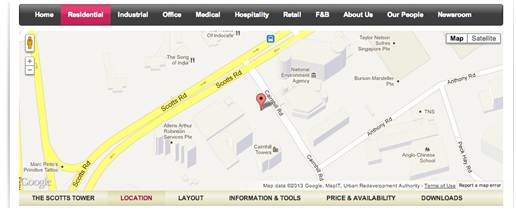
As can be seen from the map, the Scotts Tower is zoned under Master Plan 2008 as Residential. Therefore, these are technically speaking residential units.

Part of the marketing collateral says, “This development comprises 231 SOHO-concept apartments that offer breathtaking views over the height of 31 storeys, with recreational facilities abound at the sky terraces on Level 2 and Level 25.”

Nonetheless they are marketed as SOHO-concept apartments.
4-Optimized

5-Optimized


Bank loans for SOHO

Many banks' internal policies dictate that a property, whether it is considered residential or commercial is determined by its intended use. For example, if you buy a SOHO unit and then use it as an office, the bank will use commercial loan terms and interest rates.

Some banks, however, treat SOHO as commercials because they are considered as commercial regardless of the zoned use.

Other banks strictly look at SOHO or any property as residential as long as they are zoned as residential properties under URA’s master plan.

As such, getting a bank loan for SOHO properties will require some understanding of the issues. Do consult with www.iCompareLoan.com, our consultants will be most happy to guide you through and get the best home loan or commercial loan for you.

Summary

Therefore, it is very important to understand and plan your property purchase accordingly to make sure that your intended business falls within the approved office use. If in doubt, seek out a mortgage consultant who is independent of the property buying process such as www.iCompareLoan.com for a discussion.  

Read more articles at  
PropertyBuyer.com.sg/articles
SingaporeHomeLoan.net/blog/  
iCompareLoan.com/resources/category/faq/

Thursday, January 31, 2013

Things You Should Be Aware of in Commercial Property Purchases

by SUSAN TEO and PAUL HO


With the host of cooling measures rolled out in the residential market by the Singapore's government to avert a property price bubble, investors are gleaning more investment potential in commercial properties. This segment of properties is exempted from Additional Buyer's Stamp Duty (ABSD), Seller's Stamp Duty (SSD) and restrictions on foreigners' ownership – all of which affect the residential market.

In Singapore, there are two ways to buy a commercial property:
  • As an individual or;
  • As a corporation [via private limited or limited liability partnership (LLP)]
The subsequent sections proceed to highlight key points a budding investor in the commercial property landscape should take note of.

No utilisation of Central Provident Fund (CPF)

If you are making the purchase as an individual, do bear in mind that you cannot dip into the savings in your Ordinary Account of the Central Provident Fund to settle the downpayment or monthly loan instalment for the commercial property.

This means the downpayment has to be wholly funded by cash.

For the loan repayment, you will have to be prepared to incur cash outlay if the rental yields are inadequate (assuming that you are planning to lease out the property).

Property tax

Same as for a second residential property, or an only residential property that is wholly rented out or left vacant, the tax is a flat 10% of the annual value of the property.

But if you fail to lease out the commercial space, you may apply for a vacancy refund of the property tax. This vacancy refund also applies to a residential property.

Goods and services tax (GST)

Unlike for residential properties, the buying of commercial spaces from a GST-registered company is subjected to a 7% GST. An individual making the purchase will have to bear the GST himself.

However, if you are a GST-registered company - all companies with a turnover exceeding S$1million have to register for GST – you can make claims for the GST incurred on your purchases. Thus shrewd individual investors may set up companies expressly for a financial transaction, termed as Special Purpose Vehicles (SPVs), to circumvent the GST payment.

For companies with turnovers below S$1million, GST-registration is on a voluntary basis, subjected to certain requirements. Do note that being GST-registered comes with responsibilities. Check out what these are at IRAS.

Notably, the GST cannot be financed by the property loan. Buyers will have to stump up cash for this.

Rental yield and capital gains opportunities

It is estimated by Colliers Internationals that the yearly average gross yield of commercial spaces approximates 5%, compared to 2-3% for residential property. However, this higher gains can be offset by the steeper maintenance cost and renovation works generally required by tenants.

Generally, the maintenance charge for a commercial unit is expected to be higher than for a residential property. Also, more may need to be splurged on basic setup, particularly for shop units leased out for business.

An exception are HDB shops with their lower maintenance fees of S$170 to S$250. But these properties tend to come with more restrictions such as the type of businesses permitted. Applications must also be made for renovation.

Still, small supply and strong demand can drive up the asset value of strata commercial property, making them worthwhile buys.

In land-scarce Singapore, strata-titled shops/offices are in limited quantity because most of the commercial spaces are owned by real estate investment trusts (REITs), and many of these REITs are in turn owned by the Government through proxies. As of 4Q2011, the supply of strata-titled offices in Singapore is estimated to be of 11.05 million sq ft, making up 14.2% of the total office stock (Bright Spot in Singapore Property Market: Strata-titled Office, Colliers International,pg 2). The stock of strata-titled shops also faces a similar small supply.

In addition, the slew of regulations in the residential market has diverted investors' attention to the commercial sector. Together with today's low interest rate environment, the two have fuelled demand.

Thus investors can make capital gains through direct sales.

Some investors are also looking toward en-bloc sales to make profit. In April 2012, in collective sales, strata office units at Parkway Centre and Burlington Square sold for $1,043 per sq ft and $1,318 per sq ft, respectively.

Besides capital gains, investors maybe hoping to profit from rental yields. However, official statistics on the occupancy rates for strata-titled shops and offices are not available. This makes reliable estimation of rental demand in the past, present and future difficult. Hence investors should be cautious if they are looking to profit from this avenue.

All in all, with more supplies coming on-board - either from strata or non strata developments - downward pressure on property values and rental is possible. Hence, only selective buys are recommended.

Tenure

Commercial/shop spaces in Singapore usually comes with 30-, 60-, 99-, or 999-year lease. Some may be freehold. For 99-year and shorter leasehold units, buyers should be mindful that financing institutions may quote a lower loan quantum for units running low on their lease.

Loans

Borrowers for commercial properties are allowed to take a loan-to-value ratio (LTV) of up to 80%, even with outstanding residential mortgages. The maximum loan tenor typically stands at 30 years. However, loans for commercial property tend to command a higher interest rate relative to residential property loans. Like the latter, these loans come in
  • Fixed Rate Package
  • Variable (Floating) Rate Package
The requirements for a commercial loan, however, are more stringent. For example, the LTV ratio is contingent on whether the property is for owner-occupation or investment, with the latter subjected to stricter criteria by some banks. The next section explains the approval conditions in greater detail.

Credit worthiness and approval for commercial loans in Singapore

For purchases made under your name only your income, outstanding debts and credit history will be assessed. The maximum LTV ratio for a commercial mortgage is set at 80%, even with existing housing mortgages. But financing institutions will take a holistic approach in deciding whether to grant you a 80% loan.

For purchases made under a private limited or LLP company, the financiers will evaluate if the company has a cash flow record over the past few years that is sufficient to fund this investment. For instance, a company earning a monthly profit of S$15,000 deposits it into the company's account in a timely manner, the lenders can, thus, lend up to 60 to 80% (typically) of this S$15,000. In other words, you can obtain a loan up to 60 to 80% of the debt servicing ratio (DSR). This is much higher than the DSR for residential property bought by an individual.

Conversely, buying under a private limited or LLP company without adequate cash flow or profit (or if the companies are special purpose vehicles), may result in the banks requiring that the directors guarantee any loans taken by the company under their individual capacity. The directors may also need to be Permanent Residents or Singaporeans. In many cases, these directors will need to furnish documentary proof that most of their incomes are derived from that company. If they earn their income from elsewhere, some banks will not grant the loan even with them as guarantors. While others may.

From time to time, credit officers of the financiers will impose new rules and conduct additional documentation checks. Often, credit officers may ask for more supporting documents if they want to do tighter cross checks.  

Read more articles at  
PropertyBuyer.com.sg/articles
SingaporeHomeLoan.net/blog/  
iCompareLoan.com/resources/category/faq/  

References
Michelle Tee and Koh Siok Hui, Bright Spot in Singapore Property Market: Strata-titled Office, Colliers International White Paper March 2012, Web

Wednesday, January 23, 2013

What is the True Interest Cost for Buying a Property?

by PAUL HO
Many self-styled Finance or Property gurus have touted some universal motherhood statements to people who are awed by their "brilliance" or fanfare.  

"Do you know that you could end up paying more interest than the price of your house? For example, if you were to take a 100% loan for a property priced at $2m. At an interest rate of 5.30404% p.a., with a 30-year tenure, the total interest payable is $2,000,000.05.”

The guru asked. And soon, he/she shows you an interest table. And bingo!!! Everyone claps in agreement. They have just been shown financial utopia. How true is that?


Sensationalization: trivial or true financial wisdom? 

These kind of "education" smacks of sensational half truths. At the same time, they do not fully impart knowledge to people about the cost and benefit of debt. Total avoidance of debt hurts your financial well-being as you may miss out on many investment opportunities while total acceptance of debt could give you very high returns and make you a multi-millionaire or a bankrupt in a very short time. In this study, we try to limit this debt issue to Singapore property investment for simplicity.

As an illustration of home loan interest costs: - 

The scenario that these finance or property gurus often use applies only to a very narrow set of conditions. Only when interest rates are higher than 5.30404% and inflation must be ZERO before the total interest (at present value) that you paid will be higher than the price of the house. Let us assume a loan quantum of $2,000,000 and the property price is also $2,000,000. (For simplicity's sake)

• Tenor = 30 years
• Home Loan Interest Rate = 5.30404%
• Assumed Inflation = 0%
• Total Interest Paid = $2,000,000.05 (Nominal value)
• Total Interest Paid = $2,000,000.05 (Present value)

Only at a rate of 5.30404% and above will the total interest exceed the price you paid for the house. However as you can see, this is on the condition that the inflation is 0%.

Therefore, it is costly only if inflation is zero.

This is because it makes no sense to compare the value of $2,000,000 which you have to pay now to interest payments in the future. It’s not a fair comparison. You have to bring these future costs back to the present for a valid comparison.

How does inflation affect your property investing decision? 

If inflation is not ZERO, but 4.5%, then the total interest paid, adjusted for inflation to reflect the present value will be $1.291m and not $2m. Therefore, it will be relatively cheaper.

Of course, this is the official inflation figure, if you are currently about to purchase a 2.5m dollar landed property, it is evident that you are fairly well off.

At this wealth bracket, your consumption pattern may be different (perhaps higher) from that indicated by the Consumer Price Index.

• Tenor = 30 years
• Home Loan Interest Rate = 5.30404%
• Assumed Inflation = 4.5%
• Total Interest Paid = $2,000,000.05 (Nominal value)
• Total Interest Paid = $1,291,258.96 (Present value)

Therefore the interest cost at present value is actually much lower - $1,291,258.96.

If interest rates stay low at 2.5% throughout the 30 years

• Tenor = 30 years • Home Loan Interest Rate = 2.5%
• Assumed Inflation = 0%
• Total Interest Paid = $844,870.47 (Nominal value)
• Total Interest Paid = $844,870.47 (Present value)

As you can see, the cost would be dramatically reduced to $844,870.47 over the course of the loan.
 
If inflation stayed at 2.5% throughout the 30 years 

• Tenor = 30 years
• Home Loan Interest Rate = 2.5%
• Assumed Inflation = 2.5%
• Total Interest Paid = $844,870.47 (Nominal value)
• Total Interest Paid = $664,771.43 (Present value)

If inflation is greater than zero (let's say 2.5%), then the total interest paid adjusted to present value is less than that of the nominal value. This is because the value of money in the future is smaller. After adjusting for inflation, the money that you pay in the future (say at the 20th year) is only 61.81% of the value today. If you paid $21,947 in interest for the 20th year, that is only worth $13,566 after adjusting for inflation.

If we modify the inflation figure to 5% throughout the 30-year loan 

• Tenor = 30 years
• Home Loan Interest Rate = 2.5%
• Assumed Inflation = 5%
• Total Interest Paid = $844,870.47 (Nominal value)
• Total Interest Paid = $536,410.68 (Present value)

This time, you end up incurring $536,410.68 in interest cost when inflation is set higher. Therefore, the higher the inflation rate, the lower the interest cost (at present value).

What is the "Rental Cost" of property in Singapore? 

But let's assume a not so ideal case where you are paying 5.30404% interest and an inflation of 4.5%.

• Tenor = 30 years
• Home Loan Interest Rate = 5.30404%
• Assumed Inflation = 4.5%
• Total Interest Paid = $2,000,000.05 (Nominal value)
• Total Interest Paid = $1,291,258.96 (Present value)

Your interest cost per month is $1,291,258.96 / 30 / 12 = $3,586.83. At a cost of $536,410.68 (based on 2.5% interest and 5% inflation) over 30 years, marked to present value, you will end up paying $1,490 per month of "Rental" interest cost. ($536,410.68 / 30 / 12) So the “interest” or “rental” costs would be around $1490 to $3586 per month. For the same class of property, you would probably be paying $6,000 to $8,000 a month for rental in today's Singapore landed property market.

So buying a property is better than renting a landed property? 

The answer for whether it is better to buy or rent lies in answering these few questions: -

• Although the interest cost may be cheaper than renting, but don't forget the principal payment as well. The outlay is significant. Can you afford it?
• Is the price of the property already at an elevated level that looks likely to fall back?
• Are you planning to stay or to invest?
• Are you buying a landed property to pounce on future opportunities or waiting to expand the building when it is allowed?

Once you have these answers, you can get in touch with the mortgage consultants at www.iCompareLoan.com to sort through the details at (sms/text) 9782 8606 or through email.
 
What about the opportunity cost of committing the principal amount for a landed property?

If you didn't buy a property, and assuming you had the discipline to invest the money that would have gone into paying down the principal. Then you will need to calculate what you could have earned (annualized returns) of your funds.

If you did not buy a landed property and instead invested that $2 million dollars, at zero returns over 30 years, you would end up accumulating $2 million in cash (30 years later), if you invested at a return of 0%.

What is the opportunity cost of buying a landed property at 6% returns? 

• Tenor = 30 years
• Home Loan Interest Rate = 2.5%
• Assumed Inflation = 2.5%
• Total Interest Paid = $844,870.47 (Nominal Value)
• Total Interest Paid = $664,771.43 (Present value)
• Investment Return = 6%
• Total Sum of Money from Investments = $4,646,154.13 (future)

At 6% annual returns, you would have accumulated $4,457,510.41 (future value at end of 30 years) at 0% inflation. This value is equal to a potential value to of $4.46m.

At 2.5%, the time-value of money 30 years later is equal to 47.99% of today's value. The potential gains from investment is $2,229,602.63 in present value if you had not invested in the landed property.

So if you include the opportunity cost, housing loan interest cost and other factors such as risks of holding onto the property, then buying a property becomes a less clear and less straight forward decision.

The key parameters things that affect these decisions will be (non-exhaustive): -

• Interest rate
• Loan tenor
• Inflation rate
• Expected average investment returns

Total interest cost and opportunity cost 

By adding $2,229,602.62 (opportunity cost) + $664,771.43 (Interest cost) and dividing it by 30 and then by 12, you end up with $8,039.93 of "rental" per month. The better you are at investing, the higher the "cost" for you to buy a landed property.

Landed properties have option value (especially those sitting on land of 999 years or free hold leases). And these potential capital gains contribute towards reducing the opportunity cost of owning a landed property, making the decision process even more complicated and interesting.  

Read more articles at  

PropertyBuyer.com.sg/articles
SingaporeHomeLoan.net/blog/  
iCompareLoan.com/resources/category/faq/

Friday, January 18, 2013

Tips to Make Your Mortgage Financing a Breeze

By SUSAN TEO and PAUL HO


Finding the right mortgage can be a stressful experience for novice mortgage hunters, this article attempts to offer simple advice to simplify the process and safeguard your wallet (figuratively, of course!).
 

Maintain a good credit standing

Always try to maintain a good credit history as some credit-related information is collected by the Credit Bureau (Singapore) and released to credit providers on the Bureau when you apply for a loan. Avoid making late payments or defaulting on any loans with a financing institution, as these will give you a poor credit score, which will lock you out of loans with the best interest rates (as many banks may decline to offer you a loan). The credit report of the Bureau shows the account status history on all the credit facility you have on a rolling 12-month basis. For closed accounts, the status history of the last 12 months before account closure is made available. If you have been making prompt payments for all your credit facilities in the last 12 months, you will be assigned the best score of 12 “AAAAAAAAAAAA”.

Arming yourself with too many credit cards is one way to adversely affect your financial health because it provides a false sense of financial strength when all you are doing is spending on borrowed money. Without financial discipline, you will soon find yourself mired in debt. Be prudent, do not sign up for more cards than you need!

Furthermore even if you don't owe a single cent on your cards, having credit cards reduce your overall loan borrowing quantum.

To check your credit score, you may do so at the Credit Bureau (Singapore).
 

Correctly assess your financial capabilities

Do not bite off more than you can chew. Buying a large house simply to keep up with the Joneses is not good financial sense. Rather, opt for a purchase that you can comfortably finance even when your financial situation changes for the worse. Use the debt-to-service ratio (DSR) of 30% as a rough gauge of affordability:

DSR = Monthly Debt Service for Mortgage / Monthly Gross Household Income 

A note of caution will be in place here. DSR has been criticised for being only a short-term measure of housing affordability (There are other indicators of long and short-run affordability, but these are beyond the scope of this article). In the long run, household income may rise or fall, and so will the debt service. Therefore, you may want to compute DSR for different scenarios. For example, when a household member loses his job or when there is an increase in financial liability (debt service) – for instance from an unexpected spike in interest rates.

Besides the DSR for mortgage liability, you also have to take into account your overall financial liabilities. Some things to consider: do you have children going to universities or any medical conditions? If yes, when the debt service surges will you be able to service all the debts, still?

At any rate, contingencies can always happen, be sure that you can still finance your mortgage when that happens; lest you may be forced to sell that house - even at a loss.
 

Shop around for the right mortgage type and financier

Do your homework and study the different loan types available on the market. Financing institutions may introduce new loan features and types every now and then. Some packages available include the fixed rate, floating rate or a combination of both, also known as a hybrid loan.

There are also interest-offset loans. To read more about these different loan types, go here. Select the one that best suits your financial and risk profile.

Try to select a loan that will offer affordable interest rates throughout the entire life of the loan, not just in the beginning, if possible. Do not assume you can always refinance or reprice to a cheaper loan package after a few years.

MAS (Monetary Authority of Singapore – Singapore's Central Bank) may introduce new regulations from time to time, which could make borrowing easier or harder. For example, from 6 October 2012, MAS (Monetary Authority of Singapore) mandates that all new and refinanced loans have a 35-year cap on the loan tenure.

In addition, interest rate trend do not remain stationary. When the time for refinancing comes, you may find yourself in a high interest rate environment. An example follows

Loan Package X has an interest rate of 1.5% for the first three years, and 1.7% thereafter.

Loan Package Y has an interest rate of 1.3% for the first three years, and 2.0% thereafter.  

If you started off with Package Y, thinking that after three years you could refinance to a more affordable loan, you may discover - horror of horrors - that the cheapest loan starts at 1.9% now. You would be better off if you had selected Package X right from the start. But, of course, you can wait for rates to drop again before refinancing (incurring higher interest rates for several months or longer). Thus, when faced with alternatives, similar to the example, you will have to carefully consider whether the initial lower rates justify the risks of possibly higher rates a few years down the road.

If you feel lost in the sea of loan types, you can always make use of the free professional mortgage advice and home loan reports at www.iCompareLoan.com, which boosts Singapore's most advanced cloud-based home loan analysis system.

Finally, choose a reputable financing institution. You do not want a case of the financier exercising his right of “margin call” when valuations fall!
 

Understand the legal and financial jargon

After you have found your ideal loan and made a successful application, you will receive a Letter of Offer from the bank. Scrutinise this document and understand what all the conditions in the loan entail. If in doubt, consult a lawyer. Or alternatively asks the bank to clarify in plain English whatever terms you have problems understanding.
 

Changing jobs

It is best to make a loan application and complete the loan disbursement before a job change. Because for some financiers you have to be in the same job for a minimum duration before you will be eligible for a loan.
 

Adding on new debt

Steer clear of applying for a new loan during the interim period after obtaining an in-principle approval but before loan disbursement.

A case in point: A week after Person A had obtained an approved-in-principle home loan, he went to purchase a car and financed it with a car loan. Two weeks later, the financier who was to grant formal approval for the mortgage discovered Person A had taken a car loan too. Consequently, he substantially reduced the loan quantum. Because of the reduction, Person A could no longer afford the house so the deal fell through and he had to forfeit his 1% deposit.

Therefore it is important to check with a home loans expert before taking on a new loan obligation.  

Read more articles at  

PropertyBuyer.com.sg/articles
SingaporeHomeLoan.net/blog/  
iCompareLoan.com/resources/category/faq/

Should You Buy or Rent a Property in Singapore?

By SUSAN TEO and PAUL HO


Many factors come into play when deciding between buying or renting a property in Singapore. The booming rental and sales market in the island suggest that people are always on the search for living spaces. What then are the factors that property buyers should consider when choosing between the two?

Level of commitment

Renting a house as opposed to buying provides people with more freedom to relocate. The moment the rental contract expires, you can move. Any move before that is possible, but that will mean the forfeit of your deposit.

At times you may find your neighbourhood or neighbours to be unsuitable, renting allows you to uproot easily.

For some people, renting is a lifestyle option because it gives them the flexibility of changing their living environment and homes every now and then.

In contrast, buying a house requires more commitment as people are unlikely to move every few years due to the cost of selling and buying. For example, if you are financing your house with a loan, you have to incur a penalty for early repayment. Not to mention the agent fees and administration costs involved. Most importantly, there may be capital losses if you are selling during a property slump!

Nevertheless, having a place you can call your own brings with it benefits. You can experience pride in being the proud owner of a beautiful house. You also have every right to renovate it as your taste dictates and your pockets allow (or let it fall into a decrepit state if you so wish!).

Down-payment

Besides intangible considerations, the more practical concern for most is the financial aspect.

A housing purchase is a major financial commitment. Most people have to spend their entire working life, or even beyond, to pay off their mortgage.

But even before being eligible for that housing loan, you have to come up with the down-payment. If you opt for a HDB flat, unless you are eligible for a HDB concessionary loan, you will have to pay 5% or 10% of the purchase price in cash. Using of CPF fund to pay for this component is not allowed. Do note that when buying a HDB flat, whether on the open market or a direct purchase from HDB, not everybody is eligible for a HDB concessionary loan. Hence, taking a loan from a private financing institution becomes the next alternative.

For private properties, mortgage financing by a private institution is the only choice. Identical to a purchase for a HDB flat using a private loan, you will have to stump up a cash component for the down-payment. With no existing home loan, this will be 5% or 10% (if the loan tenure exceeds 30 years or extends beyond age 65) of the purchase price. With an existing loan, it jumps to 25%.

Raising the cash component of the down-payment proves to be a stumbling block for many, particularly for younger people.

Thus, renting becomes an option when you want to have a place to live in, but you are unable to stump up the cash for the down-payment to buy a house.

In another scenario, you have the means to pay for the down-payment, but you have a more lucrative investment compared to a housing purchase. As a result, you prefer to rent instead of buying. In such a case, you will have to carefully weigh whether your investment will reap you a higher capital gain than a house.


A concrete illustration of the cost of buying vs renting

To compare the cost of renting and buying, we will proceed to use real data; namely the median rental and sale price of Beacon Heights at Mar Thoma Road.

Table 1: BEACON HEIGHTS
Period
S$ psf
(Assuming a size of 1000 square feet)
S$
Median Selling Price
Sept' 12
851
851,000
Median Rental
3Q12
3.796916
3,797
Source: URA Real Estate Information

Using the median S$ psf from URA, we assume a 1000 square feet apartment to work out the median selling price and rental.

Cost of renting
Table 2: Renting a 1000 sq feet unit at Beacon Heights
 
3Q12 Median Rental (S$)
+ 30% (S$)
- 30% (S$)
Monthly Rental
3,797
4,936
2,658
Monthly Maintenance Fee
400
400
400
Total Annual Cost
45,963
59,632
32,294

As rental changes over time, we include the scenarios when it rises or falls by 30%.

Cost of renting over a 3-year period

Table 3: Renting a 1000 sq feet unit at Beacon Heights for 3 years
 
3Q12 Median Rental (S$)
+ 30% (S$)
- 30% (S$)
Total Cost
137,889
178,896
96,882

Cost of buying

Table 4: First-Year Cost for Buying a 1000 sq feet unit at Beacon Heights
 
Scenario 1
Scenario 2
Scenario 3
Price (S$)
851,000
851,000
851,000
Down-payment (S$)
170,200
170,200
170,200
Stamp Duty (S$)
15,024
15,024
15,024
Loss of Interest on Down-payment and Stamp Duty
1%
1%
1%
A - Opportunity Cost (S$)
1,852
1,852
1,852
Loan Quantum (S$)
680,800
680,800
680,800
Interest Rate (p.a.)
1.5%
2.5%
3.5%
B - Annual Interest Payment (S$)
10,212
17,020
23,828
C - Annual Maintenance Fee (S$)
4,800
4,800
4,800
D - Owner-occupier Property Tax* (Estimated) (S$)
1582.56
1582.56
1582.56
Total Annual Cost (S$) (A + B + C + D)
18,446.56
25,254.56
32,062.56
*To learn the computation, go here.

Cost of buying over a 3-year period

Table 5: Buying a 1000 sq feet unit at Beacon Heights for 3 years*
 
Interest Rate (p.a.)
1.5%
2.5%
3.5%
Year 1 Interest Payment (S$)
10,212
17,020
23,828
Year 2 Interest Payment (S$)
9,940
16,207
22,532
Year 3 Interest Payment (S$)
9,515
15,414
21,283
Total Interest Payment (S$)
29,667
48,641
67,643
Total Opportunity Cost (S$)
5,556
5,556
5,556
Total Maintenance Fee (S$)
14,400
14,400
14,400
Total Property Tax (S$)
4,747.68
4,747.68
4,747.68
Grand Total (S$)
54,370.68
73,344.68
92,346.68
*Assumes that interest rates are fixed for the 3 years  

Savings from buying a house versus renting (3-year horizon)

Table 6: Cost saving from buying (3-year horizon)
Interest Rate (p.a.)
1.5%
2.5%
3.5%
A - Rental (S$)
137,889
137,889
137,889
B - Total Buying Cost (S$)
54,370.68
73,344.68
92,346.68
Savings (S$) (A-B)
83,518.32
64,544.32
45,542.32

So it would seem that there will definitely be savings from buying a house compared to renting. Is that really the case?

If property prices stayed stagnant, that would definitely be the case. However, prices of properties tend to fluctuate.

Currently, the asking price for units at Beacon Heights range between S$1,000 to S$1,300. Hence if you happen to buy at S$1000 instead of S$851, the cost saving will be substantially lower.  

Read more articles at  

PropertyBuyer.com.sg/articles
SingaporeHomeLoan.net/blog/  
iCompareLoan.com/resources/category/faq/

Thursday, January 10, 2013

Factors to Consider in Buying a Residential Property in Singapore

By SUSAN TEO and PAUL HO

Due to the success of Singapore's public housing policy, which begins in the 1960s, 80% of the Singapore's populace live in HDB flats today. Private housing are mainly for higher income earners. Those considering buying a residential property in this island nation have to take into account a variety of factors, we will take a closer look at each in turn in this article.


Reason for purchase

First and foremost, buying a property for investment or owner-occupation makes a difference. Naturally, if it for investment, the chief factor in consideration will be the capital gain. On the other hand, buying for owner-occupation makes capital gain a secondary concern. In this case, more important factors will be the current or future size of the household. A retiree or single may opt for a smaller flat. While a young, married couple may also choose a small flat if their financial means are limited, or a large flat if they are planning to have children and provided if they are rich enough to afford it.
 

Type of housing

The next consideration is the housing type. With the many types available, buyers are often spoil for choice. The below two tables compare the private and public housing segments.

Table 1: Available Housing Types in Singapore

HDB (99-year lease) Private Housing (60-*, 99-, 999- year lease; freehold)
Build-to-Order (BTO)
  • Studio Apartment (30-year lease)
  • 2-room Flat
  • 3-room Flat
  • 4-room Flat
  • 5-room Flat
Executive Condominium** Design and Build (DBSS) Executive Flat (No longer built) Executive Maisonette (No longer built) HUDC (No longer built)    
Walk-up ApartmentHigh-rise ApartmentCondominiumShoebox ApartmentSohoStrata Titled Cluster Housing
  • Inter Terraces
  • Semi Detaches
  • Bungalows
Landed Housing
  • Inter terraces (Type 1 and 2)
  • Corner terraces
  • Semi Detaches
  • Bungalows
  • Good Class Bungalows
  • Sentosa Landed Housing (the only landed properties in Singapore for which foreigners can buy with express approval)
* A land at Jalan Jurong Kechil is the first 60-year lease plot to be sold (on 15 November 2012); thus a 60-year private property will be available in a few years' time. ** Executive Condominium becomes private after 10 years.

Table 2: Comparison of HDB and Private Housing

HDB
Private Housing
Eligibility:Direct Purchase from HDB -
  • Singaporeans
  • Gross Monthly Household Income ≤
        $10,000
       (For Executive Condominium ≤
$12,000)

Resale -
  • Singaporeans and Permanent Residents
99-year Lease

Most Affordable Type of Housing

For Owner-occupation

Lower Maintenance Cost (Conservancy Charges)

Stringent Restriction for Leasing Out  

Minimum Occupation Period
Eligibility:Non-landed -
  • Foreigners, Singaporeans and Permanent Residents
Landed -
  • Singaporeans


60-*, 99-, 999- year Lease; Freehold  

Tend to be More Expensive

For Owner-occupation and Investment

Higher Maintenance Cost (Property Taxes, Monthly Maintenance Charges, etc.)

No Restriction for Leasing Out  

No Minimum Occupation Period
* A land at Jalan Jurong Kechil is the first 60-year lease plot to be sold (on 15 November 2012); thus a 60-year private property will be available in a few years' time.

To decide which housing type suit the buyer's budget, a commonly used measure of housing affordability is the debt-to-service ratio (DSR), defined as

DSR = Monthly Debt Service / Monthly Gross Household Income

The internationally recognised benchmark for housing affordability is a DSR of 30 per cent. For example, based on a household with a monthly income of S$3,000 buying a S$300,000 3-room HDB flat, with no housing grants, the household can take a loan of up 80 per cent of the price (assuming that they have no outstanding mortgage loan), or S$240,000. Given an annual interest rate of 2 per cent, based on a 30-year loan, the monthly installment incurred will be about S$887. This works out to a DSR of roughly 30%, which still falls within the affordable range.

Another widely used affordability measure divides the price of a home by a potential buyer’s annual income.

Nevertheless, these two measures are only short-term measures as buyers' income may change over time.

To overcome this issue, a long-term measure of housing affordability was developed by Prof Abeysinghe of the National University of Singapore, to find out more about this measure go here. When deciding between a HDB and private property, besides the affordability, buyers may also want to look at the investment potential of the houses.
 

HDB flats' investment potential

From the Government's standpoint, HDB flats are meant for living purposes and not for speculation. Hence HDB flats are subjected to a Minimum Occupation Period (MOP) of 5 years whether for a resale or direct purchase from HDB. This curbs house flipping of HDB flats.

Nevertheless after MOP, owners of larger HDB flats can make a profit by downgrading to a smaller unit. Those who are tempted to sell for a profit during a booming property market may not be better off as they will have to pay a high price for another flat. Moreover, if their current flat was bought with a housing grant, they will have to incur a resale levy when they buy a second subsidised HDB flat.

However, some Singaporeans are still profiteering from renting out their HDB flats. Under current regulations, owners of subsidised or non-subsidised HDB flats have to meet the requirement of a 5-year MOP before they are allowed to rent out their flats. Exceptions are made for owners who live overseas.

Furthermore, there are restrictions on the rental periods. For Singaporean owners they could rent out their flats for a period of 3 years after which they could request for extensions with no cap on the number of requests. For PRs, however, it is a different story. They are only allowed to rent out for a period of a year, subject to discretionary extensions, with a limit of 5 years on the total rental years allowed.
 

Private housing's investment potential

In contrast, the rental rules for private properties are less stringent. Of note is that Singaporeans are not allowed to own HDB flats and private homes concurrently within the MOP. After the MOP, Singaporeans often make a profit by living in HDB flats while renting out their private properties.

However, for adventurous homeowners who are looking at flipping private properties to increase their wealth, they are restricted by the string of anti-speculative measures instituted by the Government since 2009.

Properties acquired after 20 February 2010, are subjected to a Sellers' Stamp Duty of 4% to 16% of the selling price or market value, whichever is higher , if they are disposed of within 1 to 4 years after purchase.

In addition, for property purchases after 8 December 2011, an additional Buyer's Stamp Duty of 3% is imposed on Singapore citizens buying their third and subsequent properties. For PRs, the 3% will be imposed on their second and subsequent purchases, instead.  

Read more articles at  

PropertyBuyer.com.sg/articles
SingaporeHomeLoan.net/blog/  
iCompareLoan.com/resources/category/faq/

Friday, January 4, 2013

A Guide to Housing Refinancing in Singapore

By SUSAN TEO and PAUL HO


1. What is refinancing and repricing?

Refinancing occurs when the borrower switches from the current home loan mortgage or a commercial loan mortgage, before the end of its tenure, to another mortgage package offered by a different financial institution. It is not to be confused with repricing. Repricing is the act of switching to a cheaper package with the current financier. For example, a borrower has a 2% SOR loan package with Bank A. After some time, Bank A introduces a 1.6% SOR package and Bank B introduces a 1.7% SOR package. If the borrower switches to the 1.6% package from the same Bank A, he is re-pricing, if he switches to the 1.7% SOR package from Bank B he is refinancing.
 

2. When do you decide to refinance or reprice?

The best time to look at refinancing or repricing is when the borrower is also reviewing his investment portfolio and insurance portfolio. In order to achieve his financial goals, he will have to look at investment returns as well as expenditure. If a smaller proportion of his installment payments goes toward interest payments, it implies that he is paying off his principle (debt) quicker. So it might make sense for him to take out his home loan statement and check how much he is paying now and what interest rates his bank is charging him. Or the best time may be, right after reading this article, it only takes the borrower 30 minutes to read and it can potentially save him thousands a year. Where else can the borrower get such good returns on time spent? When considering whether to refinance or reprice: As a general rule of thumb, it is usually not worthwhile to break the contract to refinance for loans still within a lock-in period, unless the interest rate differential is substantial. If the loan is out of the lock-in period but still within a subsidy claw-back period, the home owner may approach his current financing institution for re-pricing of his loan to an existing better package (subject to approval). Some bank’s loan packages have a one-time free conversion to a cheaper package while other institutions charge a fee for conversion. Once the borrower has an offer from the current bank, he can then compare that against other options in the market. The borrower should be diligent and research on all the available home loans. However, if he prefers some free professional help, he can turn to www.iCompareLoan.com where loan experts are on hand to assist to help him make an informed decision. iCompareLoan.com maintains over 200 active packages, and provides a detailed home loan report. (www.iCompareLoan.com is also used by independent financial advisory firms, mortgage brokers as well as property agents to provide detailed home loan analysis for their customers.)
 

3. What are the reasons for refinancing?


a. Reduce interest payment

For most people, saving on interest payment is a main motivation for refinancing. Typically, the interest rate for a home loan increases after the first 2 or 3 years. This is true whether for a fixed or variable rate loan. Thus the refinancing numbers is highest after the fixed rate period ends, subject to other considerations. Below illustrate how much borrowers can save from interest payment if they change to a loan with a lower interest rate.

Current loan:

Outstanding loan amount: $800,000

Interest rate: 3.5% fixed for 3 years

Tenure: 30 years

Year
Monthly Installment
Monthly Principal Paid
Monthly Interest Paid
Annual Principal Paid
Annual Interest Paid
Balance
1 $3,592.36 $1,300.01 $2,292.35 $15,353.02 $27,755.27 $784,646,98
2 $3,592.36 $1,346.25 $2,246.11 $15,899.08 $27,209.21 $768,747.89
3 $3,592.36 $1,394.13 $2,198.23 $16,464.57 $26,643.72 $752,283.33

Total interest paid over 3 years is $81,608

New loan: 

If you are able to refinance your loan to a lower rate, for example:

Year 1 – SIBOR + 1% (Assume that SIBOR = 0.5%) = 1.5%

Year 2 – SIBOR + 1% (Assume that SIBOR = 1%) = 2%

Year 3 – SIBOR + 1% (Assume that SIBOR = 1.5%) = 2.5%

Year
Monthly Installment
Monthly Principal Paid
Monthly Interest Paid
Annual Principal Paid
Annual Interest Paid
Balance
1 $2,760.96 $1,785.33 $975.63 $21,277.43 $11,854.11 $778,722.57
2 $2,950.84 $1,683.53 $1,267.31 $20,018.45 $15,391.61 $758,704.12
3 $3,142.08 $1,597.61 $1,544.48 $18,953.58 $18,751.41 $739.750.55

Total interest paid over 3 years is $45,997.13.

The difference in interest payment ($81,608 – $45,997.13) is $35,610.87! Imagine you can pay for 3 Rolex watches or a 2 - to 3- carat diamond ring with this amount. But, of course, there are other considerations in refinancing such as the person’s age, the outstanding loan tenure applicable as well as his/her debt servicing ratio, credit situation and etc. These will be dealt with in another article.
 

b. Change loan duration

For some people, they may have an unexpected increase in financial obligation or have suffered a pay cut. This makes servicing of the loan at the current monthly installment amount difficult to sustain. As a result, taking a longer duration loan to reduce on the monthly payment becomes desirable, although the interest payable over the entire life of the loan will be higher.
 

c. Change in credit standing

Conversely, for others their financial strengths may have improved since they first took the loan, so they may want to refinance to a shorter duration loan to save on interest payment. Or that they may have improved their credit standing enough to have a wider choice of bank packages.
 

d. Change in interest rate environment

If the interest rate environment has become dovish, reducing the loan tenure may not even significantly increase the monthly repayment amount. This can translate to interest savings over the entire life of the loan. For example, paying $800 per month over 30 years adds up to $288,000; whereas paying $850 over 25 years, sums up to $255,000. (However, do note that this is a simplified example as it simply adds up the interest costs over the years at nominal value without considering the time-value of money.)
 

e. Change the type of loan packages

According to circumstances, borrowers may like to change the type of home loan package.
A case in point:
During a low-interest rate climate, savvy borrowers may prefer to capitalise on low interest payments by taking a market-pegged interest rate variable package. But when these borrowers think that interest rates are starting to climb, they may try to change the loan to a fixed rate package for some years so as to be able to lock in lower rates and better manage their cash flow. Fixed rate packages are usually more expensive, but provide the most stability as rates are kept fixed for up to the first 3 to 5 years of the loan tenure. There is no perpetual fixed rate being offered by banks in Singapore at the current moment.
 

f. Some refinance to obtain cash out; generally known as equity loan (Not applicable to HDB flats)

Home owners can secure cash via an equity loan by refinancing. The terminologies of equity loan and term loan are loosely interchangeable, though the correct terminology should be called equity loan. When there is sufficient equity in the property, banks may allow borrowers to take out an equity loan (term loan) secured by the property. A term loan secured against a property cannot be used as down-payment towards another property. This is MAS’ way to prevent the risks of property market bubble from forming. Nonetheless, it is advisable to take a term loan only if the borrower can hope to make a better return from this cash-out to offset the additional interest incurred from the larger quantum loan.
 

4. Things to look out for when refinancing


a. Clawback and Lock-In period

Most loans have a 3-year timeframe (aka Clawback period), in which early full repayment of the loan can result in a refund of subsidies such as legal and administration cost. Typically, there is also a lock-in period of 2 to 5 years, during which any redemption of the loan will be subjected to a 1.5% penalty of the redeemed amount. Do note that some loan packages do not have a Clawback period or a Lock-In period. Anyway, if the loan happens to have these conditions, the borrower will have to consider whether the benefit outweighs the cost of refinancing during the penalty interval.

Returning to our previous example of a $800,000 loan quantum,
• Estimated interest saving from refinancing = $35,610.87
• Estimated cost of refund of subsidy = $3,000
• Estimated cost of early repayment penalty = $800,000 x 1.5% = $12,000
• Total Saving = $35,610.87 - $12,000 - $3,000 = $20,610.87

This example shows that refinancing during the penalty period can still result in savings. To calculate the months it takes to breakeven, or reach the total cost of $15,000, we present it in the below table.

Monthly Installment for Current Loan Monthly Installment for New Loan Monthly Saving Annual Saving Annual Saving to Reach the Cost of $15,000 No. of Months
Year 1 $3,592.36 $2,760.96 $831.40 $9,976.80 $9,976.80 12
Year 2 $3,592.36 $2,950.84 $641.52 $7,698.24 $5,023.20 7.83
Total: $15,000.00 19.83

The borrower will need 20 months to breakeven. Hence whether it is worthwhile to switch will depend on his financial circumstances.
 

b. Having two loans with different expiry dates

For some financing institutions' packages, they come with the condition that all loans have to be redeemed on a specific day. But each loan in the package has a different expiry date; thus borrowers may still have to bear the penalty of repaying the loan with a later expiry date. An example: Package A has a • home loan of $1,250,000, commencing on 15 January 2009, expiry date: 15 January 2012 • term loan 1 of $500,000, commencing on 27 February 2009 , expiry date: 27 February 2012 By redeeming the home loan (which has to be done on the expiry date to avoid penalty charges), the borrower will also have to redeem term loan 1 on the same day. As the expiry date of term loan 1 is 27 February 2012, he will incur a 1.5% penalty on $500,000.
 

c. Lure of lower interest rate when changing from a fixed to a variable loan package

Borrowers should be aware that interest rates are prone to fluctuations. Hence they should be prepared for the event of a rise in rates and perhaps check out our interest rate sensitivity calculators here. They should calculate the monthly installment and interest payment for two scenarios: a low interest rate and a high interest rate environment.
 

d. Years into the current mortgage

Usually, as the duration of the loan progresses, more of the installment payments will go toward the payment of the principle. This will build up equity. In the beginning of the loan, installment payments tend to go toward the settlement of interest. Hence, refinancing at the later stages of the mortgage may not be a good idea as it restarts the amortisation process. Detailed calculation will be needed to ascertain whether it is worthwhile to switch.
 

e. Moving house

If home owners are planning to sell their home within a few months, it is usually unwise to refinance. This is because it takes some time before the savings exceed the costs of refinancing. Secondly, they may incur the penalty of the clawback period or lock-in period of the refinanced loan or legal conveyancing fees, valuation fees and other incidental fees.
 

5. What to do for the refinancing applications?

Finally, the borrowers shall submit the application forms to those financing institutions which match their financial profile and can provide a lower rate. Documents required may vary. Some banks may require the original letter of offer from the first bank, so as to calculate the maximum tenure they can offer (under MAS' rule, refinancing is capped at 35 years). The maximum loan tenure must take into account (minus) previous loan duration already taken.   

Read more articles at  

PropertyBuyer.com.sg/articles
SingaporeHomeLoan.net/blog/  
iCompareLoan.com/resources/category/faq/

Wednesday, December 26, 2012

Understanding SIBOR and SOR Based Home Loans in Singapore

By SUSAN TEO and PAUL HO

As a small, open economy that depends largely on imports for most of its needs, Singapore adopts an exchange rate policy, which curbs import-based inflation. Specifically, Singapore makes use of a managed float regime, whereby the Monetary Authority of Singapore (MAS) manages the Singapore dollar against a basket of currency of its main trading partners, but allows it to fluctuate between an undisclosed band. Thus the interest rate in Singapore is determined by world money markets. It follows closely the interest rate of the countries in the basket of currency, of which the US dollar makes up a main component. Consequently, there is a correlation between the US interest rates and that of Singapore's.

What is Singapore Inter-bank Offered Rate (SIBOR)?

SIBOR is the interest rate at which banks and financial institutions in Singapore borrow from each other. It is similar to the London Interbank Offered Rate (LIBOR). Set by the Association of Banks in Singapore, SIBOR is transparent and announced daily through the mainstream media. Many home loan packages offered in Singapore are pegged to SIBOR. SIBOR comes in different blends of 1-, 3-, 6- , 12-month. So the 1-, 3-, 6-, 12-month SIBOR are the interest rates for borrowing for 1, 3, 6 and 12 months, respectively. The longer the tenor the higher the rate is.

What is Singapore Swap Offer Rate (SOR)?

In contrast, SOR is the lending costs and the expected forward exchange rate between the US dollar and Singapore dollar. Upon maturity of the SOR tenor, there is a Forex conversion from US dollar to Singapore dollar, but there is no bid and spread, therefore the banks save money amongst themselves. As SOR can be interpreted as currency swaps between the US dollar and Singapore dollar, it has slightly more volatility compared to SIBOR and current movements impacts the trading volume of the SOR contracts. SOR is also set by the Association of Banks in Singapore and comes in different blends of 1-, 3-, 6- , 12-month.

What are SIBOR and SOR pegged home loans?

Floating (variable) interest rate loans in Singapore make use of SIBOR or SOR as the variable component in the interest rate. Most loan packages follow the 1- or 3-month SIBOR or SOR. The interest rate for the loan will be defined as spread + SIBOR or spread + SOR. What is spread? The margin that the financing institutions add to the loan is called the spread. Using a concrete example, for an interest rate of SIBOR + 1%, the +1% is the spread. The spread is usually revised upward, after the first few years of the loan start-date. As an example:

Bank X SIBOR Loan

Period Interest Rate (p.a.)
First Year 0.75% + 1-Month SIBOR
Second Year 0.75% + 1-Month SIBOR
Third Year 0.75% + 1-Month SIBOR
Fourth Year 1.00% + 1-Month SIBOR
Thereafter 1.25% + 1-Month SIBOR
 

Advantages and Disadvantages of SIBOR and SOR

Contrary to popular belief, it is not always true that during a low interest rate environment, borrowers with a SOR-pegged package will necessarily enjoy lower rates than with a SIBOR-pegged loan. Although SOR and SIBOR are somewhat correlated, and the former tends to fluctuate more, the fluctuations of SOR can be above or below SIBOR. This is seen in Figure 1, 2 and 3, which show the most commonly used tenor of 1-month and 3-month.

Figure 1: 1-Month SIBOR/SOR for Jan 2012-Dec 2012

 Source: www.iCompareLoan.com

Figure 2: 3-Month SIBOR/SOR for Jan 2012-Dec 2012

 Source: www.iCompareLoan.com
 
Figure 3: 3-Month SIBOR/SOR for Dec 2006-Aug 2012
Source: www.iCompareLoan.com

Thus borrowers will be wise to focus on the spread instead. They should opt for packages with a reasonable spread throughout the loan duration. Summarising the features of both SIBOR and SOR:
  • Shorter tenor SIBOR has usually lower rates than the longer tenor SIBOR (Because it is riskier and there is a higher opportunity cost for longer term lending)
  • Shorter tenor SIBOR is usually more volatile than the longer tenor SIBOR
  • SIBOR fluctuates less than SOR
Thus, more risk-averse borrowers may prefer SIBOR loans as they provide more stability. But what tenor of SIBOR should they choose? Recently, banks started offering 1-month SIBOR packages to borrowers. This means an increased administrative cost for the banks.

Figure 4: 1-Month and 3-Month SIBOR for Jan 1989-Dec 2012
Source: www.iCompareLoan.com

From Figure 4, a 1-month SIBOR is generally lower than a 3-month SIBOR as seen over the past 20 years, therefore borrowers may want to consider a 1-month SIBOR if the spread being offered is also attractive.

When to choose between 1-month SIBOR and 12-month SIBOR?

While a shorter tenor SIBOR may mean lower interest, but borrowers have to contend with greater instability as rates are revised at shorter intervals. For example, for a 1-month SIBOR the rate revision period can vary between 1 or 3 months, depending on the financing institutions. In contrast, with a 12-month SIBOR the borrowers may have to pay higher interest but the rate remains constant for 12 months.

Given the many factors to consider when deciding on the best loan package, the borrower may prefer to seek experts' advice, like the free professional help available at www.iCompareLoan.com or simply fill up an enquiry form at http://www.iCompareLoan.com/contact  

Read more articles at  

PropertyBuyer.com.sg/articles
SingaporeHomeLoan.net/blog/  
iCompareLoan.com/resources/category/faq/